
The global solar market is expanding rapidly, but module reliability still depends on small, overlooked components. The IEA PVPS Trends 2024 report recorded approximately 456 GW of new photovoltaic capacity in 2023. That growth increases demand for dependable sealing materials, especially in humid, coastal, desert, and high-altitude projects. A failed seal can allow moisture into the frame, junction box, or laminate edge. The damage may begin as a thin water line beneath an aluminum frame.
This guide examines the 2026 Best Solar Panel Gasket for Global Buyers through practical and technical criteria. We compare silicone, EPDM, and other gasket materials by compression set, UV resistance, ozone resistance, temperature range, chemical stability, and dimensional consistency. IEC 61215 and IEC 61730 provide important module durability and safety frameworks, although they do not make every gasket equally reliable. The IEA PVPS reports also remind buyers that long operating lifetimes are central to solar investment value.
Teresa Barnes, a photovoltaic reliability expert at the U.S. National Renewable Energy Laboratory, has stated, “Reliability is essential to the energy transition.” Her point applies directly here. A low-cost Solar Panel Gasket may appear efficient during installation, yet shrinkage after several summers can create expensive maintenance problems. Specifications can also be incomplete. That is uncomfortable, but realistic.
Buyers should request material datasheets, aging-test results, batch traceability, and samples before approving large orders. Supplier claims deserve verification. This article offers a structured starting point, not a universal winner. Climate, module design, installation pressure, and service expectations can change the best choice.
2026 Best Solar Panel Gasket for Global Buyers?
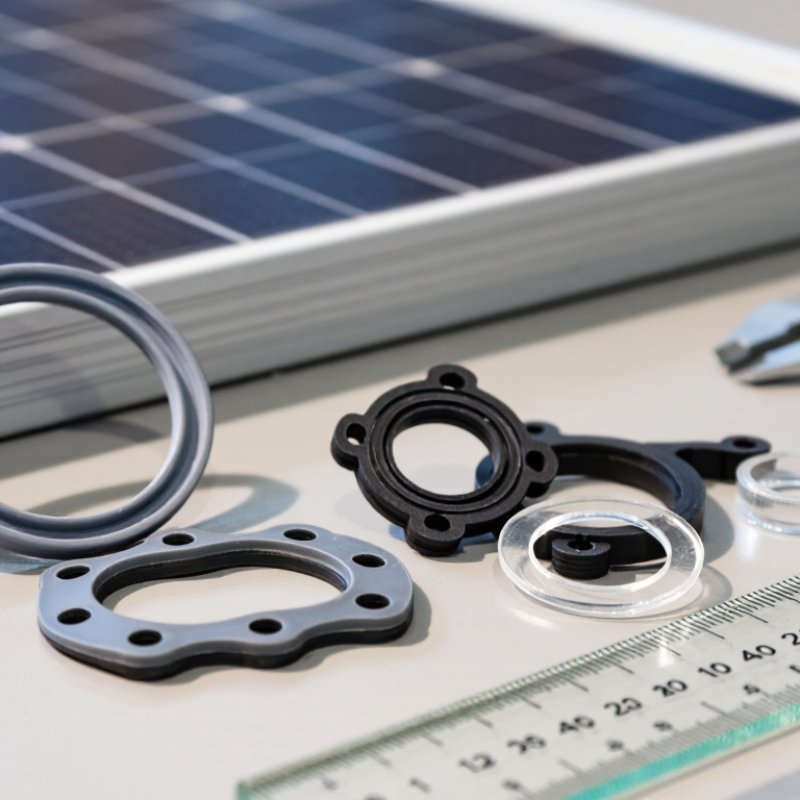
Solar panel gaskets create a controlled seal between the module frame and its mounting surface. They block rain, dust, salt spray, and insects from reaching sensitive electrical areas. A reliable gasket also reduces vibration during transport, installation, and strong wind conditions. Small sealing failures can cause moisture entry, corrosion, and insulation problems.
Most gaskets use weather-resistant rubber, silicone, or another tested elastomer. Their structure usually includes a flexible sealing body, a contact lip, and sometimes an adhesive backing. The lip must compress evenly without folding or leaving gaps. A firm inner section supports the frame, while the softer outer edge follows minor surface irregularities. Thickness matters. Too little compression may leak, but excessive compression can deform the frame.
During purchasing, check temperature resistance, ultraviolet stability, water absorption, compression recovery, and compatibility with glass, aluminum, and sealants. Measure the channel width before ordering. Do not rely on appearance alone. A gasket may look thick yet lose elasticity after repeated heat cycles. Field inspection should include corners, joints, and cut ends, where installers often create weak points. Installation is not always perfect, and that deserves honest review. Even a high-quality gasket cannot compensate for dirty surfaces, uneven pressure, or poor storage. Buyers should request test data, traceable production information, and regional compliance documents before selecting a product for large-scale projects.
In 2026, solar panel gasket selection depends heavily on material performance, not appearance. A gasket must resist ultraviolet radiation, ozone, rain, dust, and repeated temperature changes. EPDM remains widely used because it offers strong weather resistance and stable compression. Silicone performs well across wider temperature ranges. It also remains flexible in cold conditions. However, silicone can have lower tear strength and higher moisture permeability. Compression matters.
High-performance gaskets often combine elastomers with reinforcing fillers, curing agents, and carefully controlled pigments. Carbon black can improve UV resistance and mechanical strength when properly formulated. Closed-cell foam may support lightweight sealing, but its cell structure must remain uniform. Fluorosilicone can help in specialized environments, although its cost requires careful justification. Water finds gaps. Poor corner bonding, uneven compression, or inaccurate extrusion dimensions can defeat an otherwise advanced material.
Material choice should follow climate data, frame design, and expected service life. Testing should include thermal cycling, damp heat, UV exposure, compression-set evaluation, and adhesion checks. These procedures can be aligned with relevant photovoltaic safety and durability requirements. Field inspections often reveal failures at corners rather than along straight sections. That evidence deserves more attention during supplier audits. Not every seal lasts. Procurement teams should verify batch traceability, hardness tolerance, dimensional consistency, and test records. A lower-cost compound may become expensive after early moisture ingress. Small formulation changes can also alter sealing pressure.
| Material | Typical Solar Panel Use | Typical Continuous Temperature Range | Weathering & UV Resistance | Key Advantages | Main Limitations | Typical Suitability |
|---|---|---|---|---|---|---|
| EPDM Rubber | Frame channels, edge seals, junction-box seals and cable-entry gaskets | Approximately −45°C to +150°C, depending on compound and design | Very good resistance to ozone, sunlight, moisture and outdoor aging | Good elastic recovery, low cost, strong water resistance and broad availability | Poor resistance to petroleum oils, mineral oils and many hydrocarbon fluids | A practical general-purpose choice for outdoor photovoltaic sealing |
| Silicone Rubber | High-temperature frame seals, junction boxes, connectors and glass-to-frame sealing | Approximately −60°C to +200°C for many standard grades | Excellent resistance to UV radiation, ozone, humidity and temperature cycling | Wide operating temperature range, flexible performance and long-term weatherability | Higher material cost; generally lower tear and abrasion resistance than many organic rubbers | Premium choice for demanding climates and high-temperature applications |
| Fluorosilicone Rubber | Specialized seals exposed to fuels, oils or aggressive chemical environments | Approximately −60°C to +175°C, depending on formulation | Very good UV, ozone and weather resistance | Better fuel and oil resistance than standard silicone while retaining broad temperature capability | High cost and usually unnecessary where only water, humidity and sunlight are present | Niche applications requiring both outdoor durability and fluid resistance |
| Butyl Rubber | Moisture barriers, laminated seals and selected encapsulation or glazing systems | Approximately −40°C to +120°C, depending on grade | Good resistance to water and moisture vapor; UV performance depends strongly on formulation and protection | Very low gas and moisture permeability with good damping characteristics | Lower resistance to ozone, weathering and high temperatures than EPDM or silicone | Useful where moisture-barrier performance is more important than exposed-surface durability |
| Neoprene (CR) | General-purpose gaskets, mounting interfaces and selected cable or enclosure seals | Approximately −35°C to +120°C, depending on compound | Good resistance to weathering, ozone and moderate outdoor exposure | Balanced mechanical strength, flexibility, flame-resistance options and moderate oil resistance | Usually less resistant to long-term heat and UV exposure than high-grade EPDM or silicone | Suitable for moderate-duty seals when mechanical robustness is required |
| Thermoplastic Elastomer (TPE/TPV) | Extruded frame gaskets, snap-in profiles and automated high-volume sealing systems | Commonly approximately −40°C to +125°C; grade-specific limits apply | Good outdoor performance when the compound is UV- and weather-stabilized | Efficient processing, consistent dimensions, weldability and potential recyclability | Long-term compression set and heat resistance vary significantly by formulation | Well suited to precision extrusion and large-volume production |
2026 Best Solar Panel Gasket for Global Buyers?
Selecting the best solar panel gasket starts with the sealing joint, not the lowest quoted price. In practical inspections, I check compression recovery after installation, because a gasket can look perfect yet lose pressure. Measure the profile, hardness, and compression set against the frame design. Small gaps matter. An uneven corner can admit water during wind-driven rain. For long service, EPDM or silicone compounds should retain elasticity across heat, cold, and sunlight. Material choice still depends on the enclosure, adhesive system, and installation force.
Durability claims need evidence. Ask for batch traceability and test data covering UV exposure, ozone, humidity-freeze cycles, and thermal aging. Salt spray testing may help near coasts, but it cannot represent every marine environment. Check whether the report names the compound, test duration, temperature range, and acceptance criteria. Vague certificates create avoidable risk. During a factory audit, inspect splices, surface tears, corner joints, and compression marks. Install sample modules outdoors when possible, then inspect them after rain and temperature changes. Laboratory results are useful, but field exposure reveals installation weaknesses.
Weather resistance also includes dimensional stability. A gasket that swells may distort the frame; one that shrinks can open a leakage path. Ask how storage time, packaging, and profile tolerances are controlled. I would compare several production lots, not just one approved sample. That extra check feels slow. It can prevent a costly replacement campaign. Still, no gasket is universally best; climate, frame geometry, and assembly pressure must guide the decision.
How to Evaluate Gasket Durability, Sealing, and Weather Resistance
Typical continuous service-temperature ranges show how common gasket material families perform under thermal stress. EPDM and silicone generally provide strong UV, ozone, and weather resistance, while the final selection should also be verified through compression-set, water-ingress, UV-aging, and damp-heat testing. Actual limits depend on the compound formulation, profile design, and installation conditions.
Global solar capacity reached about 1,419 GW by the end of 2023, according to IRENA’s Renewable Capacity Statistics 2024. More panels also mean more rooftop failures to prevent. A gasket must resist moisture, ultraviolet exposure, compression loss, and daily thermal movement. It is a small component. Its consequences are not.
In hot deserts, select UV-stable silicone or qualified EPDM with low compression set. Sand can enter weak sealing points, while panel surfaces may exceed 70°C.
In tropical regions, prioritize low water absorption and strong resistance to mold and ozone. The IEA PVPS Trends 2024 report recorded roughly 456 GW of new solar installations in 2023, increasing demand across humid markets. Salt-air locations need materials tested under IEC 61701 conditions, not merely described as “weatherproof.”
Cold climates require flexibility after repeated freeze-thaw cycles. A gasket that hardens can leave tiny gaps around the frame. Fraunhofer ISE reports typical module degradation near 0.4–0.5% annually, but poor sealing may accelerate localized damage.
That figure is not a universal promise. Actual performance depends on installation quality, drainage, and material aging.
Request test data for UV exposure, thermal cycling, compression recovery, and salt mist. Check the gasket after one winter and one summer. Specifications can look convincing, yet field evidence sometimes disagrees.
For global buyers, the best gasket is not automatically the thickest or softest. It must match the module frame, mounting system, climate, and maintenance plan. Look for material data covering UV exposure, ozone, temperature range, compression set, and water absorption. EPDM and silicone may perform differently under heat and chemical contact. Ask for independent test reports, batch traceability, and a clear dimensional drawing. Relevant module and safety requirements may include IEC 61215 and IEC 61730, while local building and fire rules still apply. These standards do not certify every gasket. That distinction matters.
During installation, clean the contact surfaces and avoid stretching the gasket around corners. Uniform compression matters more than brute force. Excessive torque can deform the seal and stress the frame. Leave room for thermal movement where the system design requires it. Inspect joints after rain, then recheck exposed edges after several temperature cycles. In my view, buyer checklists often miss installer skill. That weakness is real.
Request samples before bulk orders. Measure hardness, profile, tolerances, and recovery after compression. Compare the sample with the drawing, not memory. I would also question unusually low prices. They may reflect thinner sections, weak testing, or inconsistent batches. No gasket lasts forever. Planned inspection remains necessary.
"*" indicates required fields